
Griffin Directory Volumes by Year
The Digital Library of Georgia Griffin collection confirms five digitized editions rather than an unbroken run. The two early books have different publishers, and the mid-century set contains three known years. Ask the Griffin-Spalding County Library about any additional print holdings instead of filling gaps by assumption.
| Collection | Years | Where Held | Access |
|---|---|---|---|
| Griffin's First Directory, Seibert & Smith | 1878-79 | DLG / library partner | Free digital viewer |
| Griffin/Barnesville, C. M. Gardner & Co. | 1882-83 | DLG / library partner | Free viewer and OCR |
| Griffin directories | 1957, 1960, 1963 | DLG and county library | Free digital collection |
| Griffin-Spalding Archives | 1820s-present collections | Welcome Center archives | On-site or distance research |
| Federal census schedules | Decennial through 1950 public | NARA / library databases | Free NARA or library access |
| Griffin Sanborn maps | 1885-1925; updates to 1961 | UGA / LOC / DLG | 1900 set free at LOC; other access varies |
The table distinguishes directory volumes from companion sources. No evidence supports annual publication between the confirmed years. A missing name may mean omission, a boundary difference, or a publication gap. It does not prove a move or death.
Search Griffin's Digital Directory Shelf
DLG hosts page images, collection records, and searchable text for Griffin city directories through its library partnership. Begin at the collection level to confirm the edition. Then search a surname, street, employer, or business term. Optical character recognition, or OCR, converts a page image into searchable text, but worn type and narrow columns cause errors.
Try spelling variants and initials. Search only the street name if a full address fails. Once a hit appears, open the scan and read nearby lines. Page images control when OCR and transcription disagree. Save the volume title, printed year, page, and section with each note.
The Flint River Regional Library genealogy resources provide the local access route.
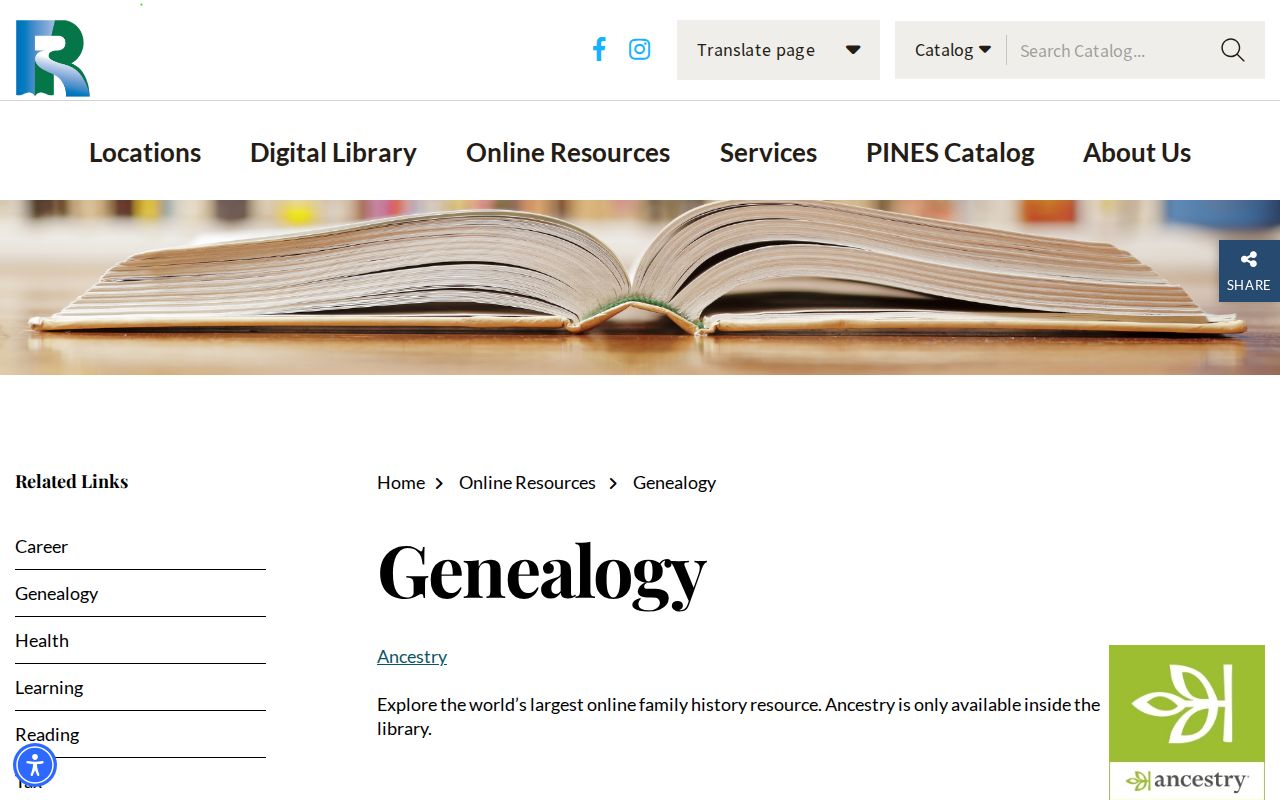
The captured library page links directory research with DLG, FamilySearch, and in-library genealogy tools, giving users a fallback when a direct text search misses.
Inside Griffin's Earliest Directories
Griffin's First Directory, Pocket Edition dates to 1878-79 and names Seibert & Smith of Macon as publisher. It gives researchers a time point close to the 1880 census. Pair the entry with land, probate, or census records rather than expecting the slim volume to act as a full roll.
The 1882-83 C. M. Gardner directory has an important quirk: it joins Griffin and Barnesville and mixes residents with planters, businesses, and officials. Confirm the section heading before assigning a listed person to a Griffin household. The publisher was based in Atlanta, another reminder that a title page and scope note matter.
Scope check. A name in the 1882-83 volume is not automatically a Griffin household entry; verify the town and section on the scan.
Decode a Griffin Directory Entry
The 1960 Nelsons city directory is volume 38, Nelsons number 1322, and runs 539 pages. Its resident supplement says entries can identify residents age 16 and older, spouses, children under 16 as a count, occupation or employer, home address, and a home-ownership mark. The actual alphabetical pages use compact abbreviations, so read the key before expanding any symbol.
| Name | Full name or initials; spouse may appear beside the resident |
|---|---|
| Work | Position or employer where the publisher collected it |
| Address | House number and street, sometimes with a residence marker |
| Home mark | h can mark home, while r can mean resides; check the volume key |
| Household detail | Spouse and a count of children under 16 may appear in the supplement |
| Historic marker | Segregated-era racial markers appear in the source and should be explained in context |
- Criss-cross directory
- A directory arranged by street and house number for reverse address work.
- Householder index
- A street-order list that points from an address to a named listed household.
- Abbreviation key
- The publisher's legend for shortened jobs, relationship terms, address marks, and symbols.
- OCR
- Machine-read text derived from a scan, useful for discovery but subject to errors.
Do not silently repeat a historic racial marker as if it were neutral modern data. Describe why the publisher used it and quote only what is needed to identify the entry.
What Griffin's 1960 Volume Counts
Nelsons reported a house-to-house canvass dated July 23, 1960. The publisher claimed 26,713 people in the street guide and 6,412 on rural routes, for 33,125 total. These are directory-company coverage claims, not U.S. Census figures. They show the scale and scope the publisher asserted, including territory beyond a narrow central-city address list.
The cover describes alphabetical residents, a numerical householder and street guide, a classified business and buyers guide, a civic section, a numerical telephone directory, and a rural-route directory. That mix lets a researcher move from name to address, reverse an address, or test a business affiliation within one edition. Each section still reflects publisher rules and the canvass date.
Griffin Archives Beyond City Directories
The Griffin-Spalding Archives and Museum is the strongest local fallback when a city directory leaves a gap. Founded in 2012 and opened in 2013, it moved in 2020 from a 1,000-square-foot school room to a 10,000-square-foot repository in the Griffin-Spalding Welcome Center. An authoritative 2020 account said its holdings span the 1820s to the present and that it had helped more than 1,600 visitors.
Family papers, photographs, maps, church histories, civic-group files, business records, oral histories, and memoirs can name people who never owned land. The 1820s starting point even predates Spalding County's 1851 creation, which can bridge a family into predecessor-county records. Current public research hours are Monday through Friday, 9 to 4, at 143 N. Hill St.; the archive also offers distance help and museum admission is free.
Griffin Directory Collection Timeline
The confirmed dates form a practical research timeline, but they should not be stretched into an annual run. Publisher changes, long gaps, and the growth of the local archive affect where a search should go next. These are collection landmarks, not proof that no other print volume ever existed.
| 1878-79 | Seibert & Smith publishes Griffin's First Directory, Pocket Edition. |
|---|---|
| 1882-83 | C. M. Gardner & Co. publishes the combined Griffin and Barnesville volume. |
| 1957 | A confirmed digitized Griffin edition covers named outlying communities as well as the city. |
| 1960 | Nelsons publishes its 539-page volume with alphabetical, street, telephone, business, civic, and rural-route sections. |
| 1963 | The latest confirmed digitized edition in the identified DLG collection appears. |
| 2012-20 | Griffin-Spalding Archives is founded, opens, and later moves into its larger Welcome Center repository. |
A search across these points should note what each publisher claimed to cover. The 1957 metadata includes Cherokee Heights, East Griffin, Highland Mills, and Experiment. The 1960 book includes rural routes. Those labels warn against equating every printed entry with the modern Griffin city boundary. For years between confirmed volumes, ask library staff about print holdings and move to census, newspaper, land, probate, or archival collections.
Map Griffin Directory Addresses
Old addresses become clearer when city directories are paired with maps and photographs. UGA lists Griffin Sanborn fire-insurance sets for 1885, 1890, 1895, 1900, 1909, 1915, and 1925, plus a 1925 base updated to 1961. The Library of Congress 1900 Griffin set is freely viewable.
Sanborn sheets show building footprint, use, material, and street context. They do not identify every resident. The Vanishing Georgia Hill Street photograph adds a 1960s visual clue: storefront signs can be checked against the closest printed volume, then tested with newspapers or business records.
Note: When an address label changes, use the plat, cross streets, parcel description, and Sanborn sheet before assuming the building moved.
Fill Griffin Directory Gaps
Census schedules supply household relationships and occupations at a decennial date. The public federal series currently reaches 1950 under the 72-year rule. Pair the early Griffin editions with the 1880 census and the mid-century volumes with 1940 and 1950. A directory can narrow the address; a census can show the household on its own enumeration date.
For a trail ending in death, ask the city for Oak Hill interment and lot records, then compare a death certificate, obituary, and probate file. Oak Hill's old-section additions opened in 1917, 1924, and 1931, with a 1938 amendment; newer additions date to 1942, 1953, and 1973. Section dates can explain where a burial falls, but they do not replace the official register.
FamilySearch offers an access path to indexed Spalding Court of Ordinary minutes from 1852 to 1905 on four reels and Georgia Probate Records through 1990. Name the Probate Court or other custodian when citing the underlying record.
Trace Families Through Griffin Directories
A city directory entry is most useful in a sequence. Copy initials, occupation, spouse, address, symbols, and page context exactly. Then move only to confirmed editions. The large gap between Griffin's nineteenth-century books and the known mid-century volumes means census, land, probate, newspaper, and archive sources must carry much of the intervening trail.
- Find the person in the alphabetical section. Copy the entry and its abbreviation key.
- Check the same edition's street or numerical section, if present, and note nearby listed names.
- Move to the next confirmed edition. Record changes in address, spouse notation, occupation, and listing status.
- Pair 1878-79 or 1882-83 with the 1880 census. Pair 1957, 1960, and 1963 with the 1950 census and later records.
- When the name disappears, test probate, obituary, cemetery, deed, and archive sources before deciding why.
Absence has several causes. A resident may have moved, died, declined listing, fallen outside the publisher's boundary, or been missed. A new owner in the deed chain supports a property transfer. A death record or probate case supports an endpoint. Without that second source, report only that the person was not found in the searched edition.