
Griffin Address History Sources
A Griffin previous residents search has several overlapping timelines. The current Spalding parcel card gives a sound start, but it does not name each person who occupied the building. Recorded deeds follow legal ownership. Directories, census schedules, and local-history files can reveal occupants, kin, firms, and street context. Each source has a different span and access route.
| Source | Years covered | Where held | What it shows |
|---|---|---|---|
| GSCCCA deed index and deed books | Online cutoff not stated; older books from county formation, subject to gaps | GSCCCA and Spalding Clerk | Grantors, grantees, recording references, legal descriptions |
| Griffin city directories | 1878–79, 1882–83, 1957, 1960, 1963 confirmed | DLG and county library | Named residents, firms, addresses, reverse street entries |
| Federal census schedules | Decennial schedules through 1950 are public | NARA and library databases | Households, relationships, work, address context |
| Sanborn maps | 1885 through 1925, plus updates to 1961 | UGA and Library of Congress | Building footprint, use, materials, older street labels |
| Probate and cemetery records | Case and register dependent | Probate Court, city, archives | Heirs, estates, death clues, burial lot |
Choose the first record by the date in question. Recent work starts with qPublic and the acquisition deed. A mid-century question benefits from a directory paired with the 1950 census. Older Griffin research often needs deed books, maps, probate, and archive material.
Start With Griffin's Current Parcel
Search the Spalding qPublic property records by location address. Copy the parcel ID, owner, situs address, tax mailing address, legal description, subdivision or lot, sale reference, and map reference. “Situs” means the physical property address. The mailing address is where tax mail goes. A difference between them can guide more research, but it proves no one's occupancy.
The parcel ID and legal description are more durable than a street label. Griffin addresses can appear with changed abbreviations, rural-route wording, or a later name. No verified citywide renumbering year was found, so a clean chain cannot assume that matching numbers always identify the same building.
Key distinction. A tax owner, a tax-mail recipient, and an occupant may be three different people.
Walk Griffin Deeds Backward
The GSCCCA Real Estate index is the online route to Spalding deeds, security deeds, liens, plats, and related instruments. A grantor gives an interest. A grantee receives it. Match the parties to the same parcel and legal description because a shared name alone is weak proof.
- Open the current parcel card and copy its legal description and latest sale reference.
- Find the present owner's acquisition deed. Confirm the county, book and page or instrument number, date, and land description.
- Treat the seller on that deed as the prior owner, then search that person earlier as a grantee.
- Repeat through each transfer. Do not treat a security deed as an ownership transfer.
- When online results stop, carry the last book and page plus the legal description to the clerk's older indexes.
- Chain of title
- The linked sequence of ownership transfers for the same land.
- Grantor and grantee
- The person giving an interest and the person receiving it.
- Legal description
- The lot, block, subdivision, or boundary wording that identifies land apart from its postal address.
The local online cutoff is not stated on an accessible official page. Call the Spalding County Clerk of Superior Court Real Estate Division at 770-467-4356 or visit 132 E. Solomon Street. Ask about the public terminal, reverse indexes, deed books, microfilm, plats, and copy prices.
Cross Griffin's Online Deed Gap
An empty web result does not end a Griffin previous residents search. It may mark an imaging cutoff, index spelling issue, or deed filed under a party rather than a street address. The counter route matters because the clerk holds the instrument, while GSCCCA is its statewide online layer.
Bring exact references. The last known book and page, parcel ID, legal description, subdivision and lot, and both party names let staff continue from the right place. The Georgia Archives county microfilm-card index is another route to older material. Spalding County began in 1851 from Fayette, Henry, and Pike Counties, so an earlier trail may turn toward a parent county.
The image below comes from that county-card catalog and shows a way to identify microfilm rather than assume every old Griffin record is online.
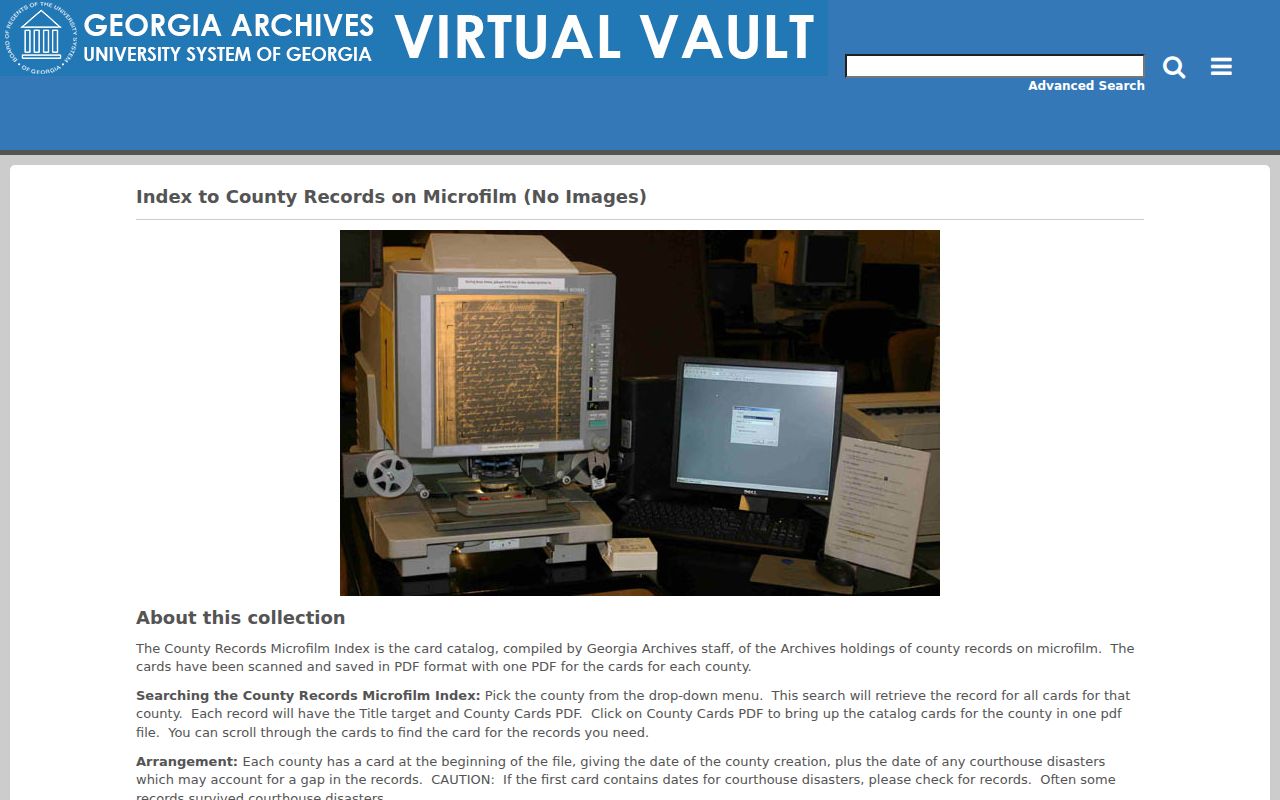
Carry the archive citation back into the chain so each link stays tied to the same tract.
Note: The 1981 courthouse fire calls for a coverage check, not an unsupported claim that a record series was destroyed.
Map Griffin Buildings Across Time
Deeds identify land, but Sanborn fire-insurance maps help date the structures upon it. UGA lists Griffin sheets for 1885, 1890, 1895, 1900, 1909, 1915, and 1925, plus a 1925 base updated to 1961. Sheet counts rise from two in 1885 to twenty-five in the updated set. A sheet may show footprint, material, use, additions, outbuildings, street names, and block layout.
Review the UGA Griffin Sanborn holdings before choosing a year. The captured source below shows that dated collection route.
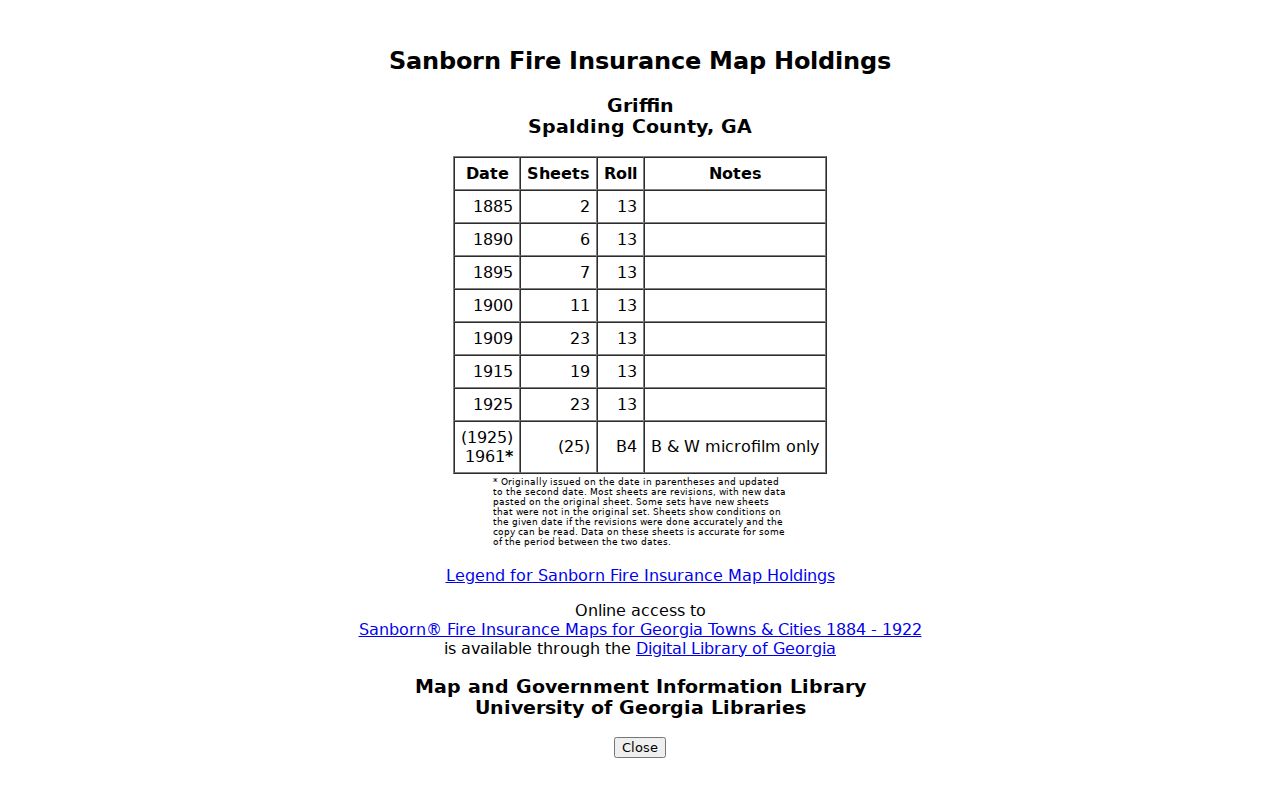
The free 1900 Griffin Sanborn set has eleven sheets. Compare cross streets, block form, and lot position with the plat and current parcel map. If the building did not yet exist, the land chain can continue, but the occupant trail should start later.
Match Griffin Residents to Owners
Ownership is only half of address history. The Digital Library of Georgia confirms Griffin directories for 1878–79, 1882–83, 1957, 1960, and 1963. The 1960 Nelsons volume has an alphabetical directory and numerical street guide, so it can move from a name to an address or from an address to a householder. Entries may include a spouse, work, employer, address, and home or residence marks.
Pair directory points with public census schedules. Use the 1882–83 volume near the 1880 census, and the later directories beside the 1950 census. Publication was not annual. A missing name may mean omission, an area outside coverage, poor OCR, or a gap between editions rather than a move.
- Copy the printed address and each abbreviation from the scanned page.
- Check the street guide for nearby numbers and cross streets.
- Locate the household in the closest public census by name and place.
- Compare household members with the deed owner without assuming they match.
- Use the next confirmed directory to test whether the household remained.
The volumes and their reading rules appear in depth on the Griffin city directories page.
Count Past Griffin Households Carefully
The 1960 Nelsons publisher reported a house-to-house canvass of 26,713 people in the street guide and 6,412 on rural routes, for 33,125 total. Those are publisher coverage claims, not Census figures. They still show why the volume can reveal past residents in Griffin's wider postal and rural-route orbit.
Nelsons described residents age sixteen and older, spouse, children under sixteen, work, employer, address, and home ownership among its fields. Historical segregation markers appear in some entries and should be explained as evidence of the publication era. Always verify OCR against the scanned image before joining a person to a Griffin address.
Close Griffin Trails With Probate
A name may disappear because of death, inheritance, relocation, or a publication gap. Probate and obituary work can connect a deceased resident to heirs and explain the next deed. FamilySearch catalogs indexed Spalding Court of Ordinary minutes from 1852 to 1905 on four reels, while Georgia Probate Records includes Spalding material within broader state coverage. The court or archive remains the source for official copies.
Ask library or archives staff about Griffin newspaper microfilm and obituary indexes because exact runs were not confirmed online. An obituary can identify kin, a church, funeral home, and cemetery, but it is a lead to compare with probate, deeds, and vital records.
Note: A probate heir is not automatically the next recorded owner; confirm the later deed or estate instrument.
Oak Hill Dates Griffin Lives
Oak Hill Cemetery adds a local time marker when previous residents end their trail in Griffin. City records identify old-section additions in 1917, 1924, and 1931 or 1938, followed by new-section additions in 1942, 1953, and 1973. A section and lot can narrow the map or register series worth asking for.
Use the City of Griffin cemetery route to ask for interment and lot records. Compare the burial date and lot owner with a death certificate, obituary, probate case, and last directory appearance. A shared plot may reveal relatives whose names never appeared on the deed.
Lawful use. Research Griffin previous residents for house history, genealogy, estates, or personal curiosity. Never use an address trail to watch, threaten, or harass a living person.
The Griffin-Spalding Archives can extend this final stage beyond courthouse files. Its holdings span family papers, church histories, civic records, business files, maps, photographs, oral histories, and memoirs, with material reaching back to the 1820s. That range predates Spalding County’s 1851 creation and may preserve a name that never entered a Griffin deed or directory. Ask archive staff about the address, subdivision, family surname, church, employer, and nearby street, then record the collection title and item date. Treat a labeled photograph or donated roster as evidence tied to its own era. Compare it with the deed chain, directory image, census household, probate file, or Oak Hill register before concluding who lived there.